Range anxiety is the quiet passenger on every electric scooter. You glance at the battery gauge at a red light, do the mental arithmetic, and wonder whether you will make it home or end up pushing a moped that suddenly weighs a great deal more than it did this morning. It is the single biggest reason riders in the United States and the United Kingdom hesitate before going electric.
The good news is that range anxiety is mostly a planning problem, not a battery problem. Once you understand what really drains the battery, learn to read the gauge honestly, and plan a route that knows where the chargers are, the fear tends to evaporate. I ride in the city and I build Urban Rider, the navigation app I cover near the end, so treat me as a biased but honest source. Here is how to stop worrying about range and get on with the ride.
What actually affects your range
Manufacturers quote a single tidy number. Reality is messier, because range is the sum of several forces working against the battery at once. These are the ones that matter:
- Speed. This is the big one. Air resistance climbs steeply with speed, so a moped held at 28 mph (45 km/h) sips far less energy than the same machine pushed to 45 mph (70 km/h). On a faster road you can lose a third of your range without noticing.
- Cold weather. Lithium-ion cells dislike the cold. Independent testing of electric vehicles has found range losses of roughly 20 to 40 percent near freezing, and a seated scooter is no exception. A 50-mile summer range can quietly become 35 miles on a frosty January morning in Manchester or Chicago.
- Hills and load. Climbing burns energy, and a heavier rider, a pillion passenger or a full top box all make the motor work harder. A flat commute and a hilly one of the same distance are not the same trip.
- Riding style. Hard acceleration away from every light is the electric equivalent of flooring a petrol throttle. Smooth, gentle inputs and a steady cruising speed stretch the battery noticeably.
- Battery age. Like any rechargeable battery, capacity fades over years and charge cycles. A three-year-old moped will not match the range it had when new, so adjust your expectations as the machine ages.
How far electric scooters and mopeds really go in 2026
Let us put numbers on it, because honest expectations are half the cure for range anxiety. In 2026 the seated electric mopeds and scooters sold in the US and UK typically quote between 40 and 70 miles (roughly 65 to 110 km) on a single battery.
A few concrete examples. The Vespa Elettrica is rated at around 62 miles (100 km) on its fixed battery, while the Elettrica X stretches that to roughly 120 miles, though it does so by adding a small petrol range-extender engine rather than a bigger battery. In the UK, popular commuter mopeds tell a similar story: the Horwin EK1 quotes about 44 miles on its standard battery, the Keeway E-Zi Mini around 40 miles, and the Vmoto Super Soco TSx about 44 miles on one battery. Fit a second removable battery, as the TSx allows, and that climbs to roughly 80 miles.
The honest rule of thumb is to take the headline figure and knock 15 to 25 percent off for real-world riding, then more again in winter. If a moped is advertised at 50 miles, plan your day around 40 in mild weather and 30 when it is cold. That margin is what turns a nervous ride into a relaxed one.
Estimate your range honestly
The trick is to measure your own riding rather than trust the brochure. For the first few weeks, note how many miles you cover before the gauge drops to a level you would not want to push past, say 20 percent. That real number, in your conditions, on your roads, is your working range.
From there, the maths is simple. Most urban commutes are short: a journey under 10 miles each way is comfortably within reach of almost any electric moped, even in winter. Trouble only appears on longer trips or chained errands, and that is exactly where a little route planning pays off. If you are weighing electric against petrol for the way you actually ride, I compared the two in electric versus petrol scooters.
Plan routes around charging and battery-swap points
The most effective cure for range anxiety is knowing, before you leave, where you could top up if you needed to. A rider who can see three chargers along the route does not worry about the battery; a rider staring at an unfamiliar map does.
This is also where the route itself matters. A navigation app that sends an electric moped down a fast dual carriageway is quietly draining the battery, because, as we saw, speed is the enemy of range. Apps built for cars rarely understand this, or that many mopeds are not even allowed on those roads. (If you are unsure what your machine may use, I covered it in can you ride a moped on the motorway.) A route that favours steady, lower-speed urban roads is usually both legal and kinder to the battery.
On battery swapping: in much of Asia, swapping is the answer to range anxiety. Gogoro alone runs more than 2,700 swap stations in Taiwan, where a depleted battery becomes a full one in under a minute. In the US and UK, though, consumer swap networks for privately owned mopeds are not yet established in 2026. Some shared rental fleets swap batteries behind the scenes, and European industry consortiums are piloting open swap standards, but for the private owner the practical equivalent is a removable battery: carry a charged spare, swap it yourself, and double your effective range.
Charging options where you live
For most US and UK owners in 2026, charging, not swapping, is how you keep moving. The reassuring part is that an electric moped is far easier to charge than an electric car.
Home charging
Most electric mopeds charge straight from a standard household socket, either through an onboard charger or by lifting a removable battery out and carrying it indoors. A UK three-pin socket delivers around 2.3 kW in practice; a US 120-volt outlet is a little slower, typically under 2 kW. Either way it refills a typical moped battery in roughly four to eight hours: an overnight job you never think about. One safety note for the UK: while occasional socket charging is fine, any dedicated charge point should be installed by a qualified electrician to stay within the wiring regulations.
Home charging is also the cheapest. Charging overnight on an off-peak electricity tariff costs a small fraction of a tank of petrol, and you start every day with a full battery, which on its own removes most range anxiety.
Public charging
Away from home, things work differently from an electric car, and it is worth being clear about this. Most small commuter mopeds, machines like the Super Soco, Horwin and Keeway, charge only from a normal mains socket and cannot plug into the public Type 2 AC charge points that line the streets and car parks of London, Birmingham and beyond. Those posts are built for cars. So in practice you top a moped up the same way wherever you are: from an ordinary three-pin socket in the UK, or a standard 120-volt outlet in the US, ideally by carrying a removable battery to a plug indoors. Only the larger, premium electric maxi-scooters tend to come with onboard Type 2 charging, so check your own machine before counting on a public point.
The upshot is that public charging matters far less for a moped than for a car. With a small battery and a route that stays close to a mains socket, you rarely need a dedicated charging station at all. The real skill is simply knowing where you can plug in, which brings us to the app.
How Urban Rider takes the gamble out of range
This is the app I make, so weigh that accordingly. Urban Rider was built for scooters, mopeds and motorcycles rather than cars, and range is one of the problems it sets out to solve.
When you plan a route, the app surfaces charging stations along the way, and for each one it shows the output (so you know roughly how quickly you would charge), the network (so you know whether you can use it) and the walking distance from where you would park. You see your charging options laid out before you set off, instead of discovering them, or not, with a fading battery.
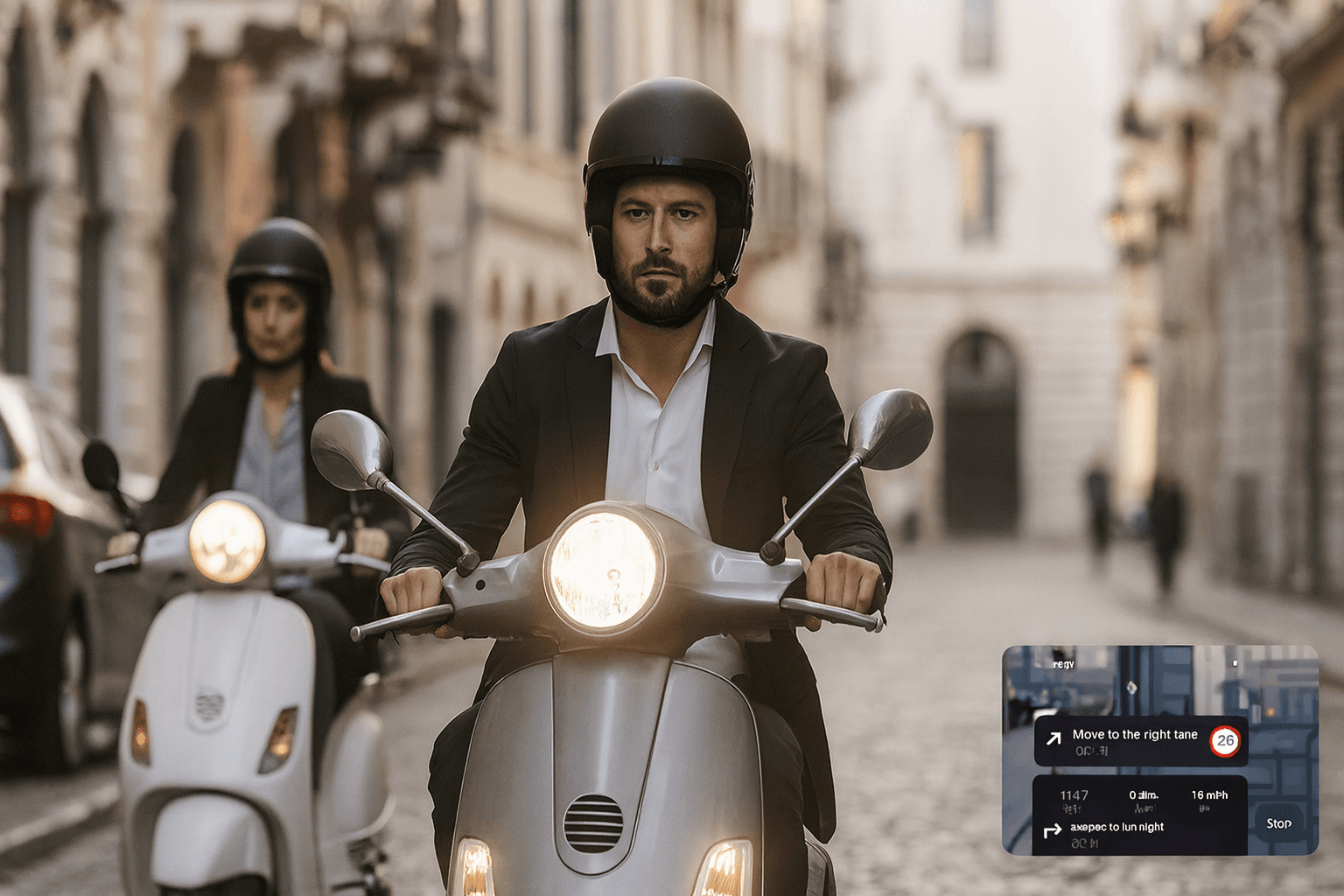
It also routes the way an electric rider should ride. Choose a scooter or moped profile and Urban Rider keeps you on roads your vehicle is allowed to use, avoiding motorways, major trunk roads and many tunnels by default. Those lower-speed roads are not only the legal choice for most mopeds, they are the gentler choice for the battery. Arrival times are modelled on real two-wheel speeds, and Minimal Mode strips the screen to the next turn, the distance and your speed, so a glance at the handlebars tells you what you need without burying the battery gauge under clutter.
The honest caveats, as always: Urban Rider is younger and smaller than the giants, it is iOS-first with an Android version in open beta, and charging-point coverage depends on the data available in your area. It will not invent a charger that is not there. What it will do is stop you guessing. If you want the wider picture on apps, I weighed up the field in the best scooter and moped navigation apps.
A simple routine that ends range anxiety
Pulling it together, here is the habit that turns electric riding from nervous to effortless:
- Charge overnight at home so you start each day full.
- Know your honest range from your own riding, not the brochure, and keep a winter margin.
- Plan longer trips with a route that shows chargers along the way, so a top-up is never more than a few minutes off course.
- Ride smoothly at a steady, lower speed: better for range, and on most mopeds the legal choice anyway.
- Carry a spare battery if your machine takes a removable one and your day is a long one.
Do that and the battery gauge stops being a source of dread. It becomes just another instrument, like the speedometer, that you glance at and forget. Range anxiety, it turns out, is mostly cured by good information, and good information is exactly what a navigation app built for two wheels is meant to give you.
Frequently asked questions
How far can an electric scooter or moped really go on one charge?
Most seated electric mopeds sold in the US and UK in 2026 quote 40 to 70 miles (65 to 110 km) on a single battery, and real-world range usually lands 15 to 25 percent below that once you factor in speed, cold and stop-start traffic. A standard Vespa Elettrica is rated around 62 miles, while dual-battery commuters and petrol-hybrid range-extender models such as the Elettrica X can reach 100 to 120 miles. Treat the headline number as a best case in mild weather, not a promise.
What drains an electric scooter battery the fastest?
Sustained high speed is the biggest single factor, because air resistance rises sharply above roughly 25 mph (40 km/h). Cold weather is next: lithium-ion batteries can lose 20 to 40 percent of their range near freezing. Steep hills, a heavy rider or pillion, hard acceleration and an ageing battery all reduce range further. Riding gently at a steady speed on flat roads gives you the most miles per charge.
Can I charge an electric moped from a normal household socket?
Usually yes. Most electric mopeds charge from a standard household outlet, either through an onboard charger or by carrying a removable battery indoors. A UK three-pin socket delivers about 2.3 kW, so a typical moped battery refills in roughly four to eight hours overnight, and US 120-volt charging is similar. In the UK you should have any dedicated charge point installed by a qualified electrician, and for occasional top-ups a normal socket is fine.
Are there battery-swap stations for electric mopeds in the US and UK?
Battery swapping is widespread in Asia, where Gogoro runs more than 2,700 swap stations in Taiwan, but consumer swap networks are not yet established for privately owned mopeds in the US or UK. Some shared fleets swap batteries behind the scenes, and European consortium projects are piloting open swap standards, but for now most US and UK owners rely on charging. Removable batteries are the practical equivalent: carry a spare, charge it indoors and swap it yourself.
How does Urban Rider help with range anxiety?
Urban Rider shows charging stations along your planned route, with the connector output, the network and the walking distance from where you would park, so you can see your charging options before you set off rather than gambling on range. It also routes scooters and mopeds onto lower-speed roads they are allowed to use, which tends to be gentler on the battery than a fast trunk road. It is free on iOS, with an Android version in open beta.