London is one of the best cities in Europe to ride a scooter or moped, and one of the most confusing. You can slip through gridlock that swallows cars whole, park for a pound a day, and skip a Congestion Charge that now costs drivers £18. But the rules change at every borough boundary, the cameras are everywhere, and a bus lane that is legal on one street becomes a £160 penalty on the next. Knowing where you may and may not ride is the difference between a fast, cheap commute and a stack of fines.
I ride a small machine through a city every day, and I build Urban Rider, a navigation app for two wheels, so treat me as a useful but interested source. This is a straight guide to riding a 50cc moped, a 125cc commuter or a bigger bike across London in 2026: where you can go, what the zones cost, where to leave the bike, and how to navigate without being routed onto a road you should not be on.
Where you can and cannot ride
Bus lanes: usually yes, but check the sign
This is the single biggest advantage of two wheels in London, and the easiest place to get caught out. Motorcycles and scooters are permitted in almost all bus lanes on Transport for London red routes, the major arterial roads marked with double red lines and managed centrally by TfL. Riding the bus lane down the A40, the A13 or through junctions on the inner ring is both legal and far faster than sitting in the general traffic queue.
The catch is that the red routes are only a fraction of London's streets. The rest belong to the 33 boroughs, many of which still restrict their bus lanes to buses, taxis and pedal cycles only. A bus lane in Hackney or Lambeth may exclude you even though an almost identical one on a red route a mile away does not. The rule is simple: read the blue sign at the start of every bus lane. If it shows a motorcycle, you are allowed in; if it does not, stay out. Enforcement is by camera, and the penalty is typically £160, halved if you pay within two weeks.
Cycle lanes and Cycle Superhighways: no
It is tempting, but do not. Under Rule 140 of the Highway Code, you must not ride or park in a cycle lane marked by a solid white line during its hours of operation. London's segregated Cycleways, the blue-branded routes along the Embankment, Blackfriars and elsewhere, are strictly for pedal cycles. Riding a powered vehicle in one is an offence and, on the busy protected lanes, dangerous to cyclists. The pavement is off limits too: riding on the footway is illegal, and across Zones 1 and 2 parking on it earns an instant ticket.
Pedestrian zones and restricted streets
Central London has a growing number of timed or permanent traffic restrictions: Bank junction in the City, parts of Soho on evenings and weekends, and the low-traffic neighbourhoods (LTNs) that boroughs have rolled out across residential areas. Many LTN filters are camera-enforced and apply to motorcycles exactly as they do to cars. A scooter does not buy you a way through a bus gate or a school-street closure.
The zones: ULEZ and the Congestion Charge
London runs two separate charging schemes, and riders get a good deal on both, but they are not the same thing and it is worth being clear about which is which.
The Congestion Charge
The Congestion Charge covers central London (broadly the area inside the inner ring road, from Marylebone down to the Elephant and across to Tower Hill) and operates 07:00 to 18:00 on weekdays and 12:00 to 18:00 at weekends and on bank holidays. The daily charge for cars and vans rose to £18 from 2 January 2026. Two-wheeled motorcycles, scooters and mopeds are exempt. You do not register, you do not pay, you simply ride in. The only exception is a large motor tricycle above the size threshold, which is treated as a car. For a commuter, this exemption alone is worth thousands of pounds a year against driving.
The Ultra Low Emission Zone (ULEZ)
The ULEZ is about pollution, not congestion, and it is far larger. Since 2023 it has covered every London borough out to the North and South Circular roads, and it operates 24 hours a day, every day except Christmas Day. Here, exemption depends on your engine, not your number of wheels. A motorcycle, scooter or moped must meet the Euro 3 emissions standard for nitrogen oxides. In practice, almost any powered two-wheeler first registered with the DVLA from July 2007 onward is compliant and pays nothing. An older, non-compliant machine pays £12.50 a day to ride anywhere inside the zone. You can check a registration on the TfL website in seconds, and there are no plans to tighten the standard before 2028. If you ride electric, the question never arises: a battery scooter is exempt from both schemes.
Parking: cheap, but the rules vary by borough
Parking is where two wheels pull decisively ahead of four. London is dotted with Solo Motorcycle Only bays, marked in white on the road surface, and they are designed for exactly your vehicle. The headline news is good: these bays remain free in around 28 of London's 33 boroughs.
Five inner boroughs now charge non-residents to use them: Westminster, Camden, Islington, Hackney and Lewisham. The fees are modest. In Westminster, the busiest of the lot, a solo motorcycle bay costs £1 for a day, £3.50 a week, £13.50 a month, £33.50 a quarter or £100 for a full year, paid through RingGo, PayByPhone or JustPark. From October 2025 the payment apps add a small transaction fee of up to 30p. Crucially, electric motorcycles park free in Westminster's bays, and the City of London publishes a map of its free motorcycle bays despite running a strict regime in other respects.
A few practical points that save money and tickets:
- Use the bays, not the car spaces. A pay-and-display car bay still expects a full car tariff even for a scooter; the dedicated motorcycle bays are the cheap option.
- Single yellow lines are usually free outside controlled hours. On most streets that means after about 18:30 in the evening and all day Sunday, but the times are on the nearest sign, so check before you walk away.
- Never park on the pavement in central London. Some outer boroughs tolerate it informally, but in Zones 1 and 2 assume it is an instant penalty.
- Anchor to the bay. Most central bays have ground anchors or stands. A bike chained to a fixed point is far harder to lift away.
Theft: the one thing every London rider worries about
Be honest with yourself about this. London has a serious problem with powered two-wheeler theft: more than 9,000 scooters, motorcycles and mopeds were stolen across the capital in the last year, according to Metropolitan Police figures. The trend is improving, with the Met reporting a fall of roughly 7 percent through 2025, but the risk is still real, and a popular 125cc commuter is a prime target.
Security pays off, and the Met's own advice is to layer it:
- Park where it is busy and overlooked. A bay on a main road with footfall and cameras is a far worse target than a quiet side street.
- Use a disc lock and a chain. A disc lock on the front brake stops a quick ride-away; a hardened chain through the rear wheel to a ground anchor stops it being lifted into a van.
- Fit a tracker and a marked alarm. Visible deterrents matter, and a tracker dramatically improves the odds of recovery.
- At home, get it off the street. A locked garage, a folding ground anchor or a motorcycle cover that hides the model all help.
Licences and what you can ride
If you are new to two wheels in the UK, the entry point is the Compulsory Basic Training (CBT), a one-day course you must complete before riding on the road, valid for two years. With a CBT you can ride a 50cc moped (and, from 17, a 125cc machine up to 11kW) on L-plates. A full AM licence, available from 16, covers mopeds limited to 28 mph (45 km/h). If you want the legal detail, we cover it in whether you need a licence for a moped, and the practical trade-offs between the two most common city machines in 50cc versus 125cc. One rule that often surprises newcomers: a moped cannot use a motorway, and we explain exactly why a moped is banned from the motorway in a separate guide.
The best way to navigate London on two wheels
Here is where a city like London exposes the weakness in ordinary navigation apps. Open Google Maps or Apple Maps on a moped and ask for a route across town, and you get a car's route: it does not know your 50cc machine cannot use the A40(M) flyover, it does not weight the bus lanes you are allowed to ride, and it times the journey for a car that can do speeds you cannot. The map is not wrong, exactly. It was simply never built for your vehicle.
This is the gap Urban Rider sets out to close, and since I make it, weigh that accordingly. Choose a scooter or moped profile and it keeps you off motorways, major trunk roads and many tunnels by default, because in the UK those machines are not allowed there. Switch to the motorcycle profile and the faster roads return, with the controls to fine-tune from there. Arrival times are modelled on real two-wheel speeds rather than the average car, which matters when a cross-town trip swings between a clear bus lane and a jammed junction.
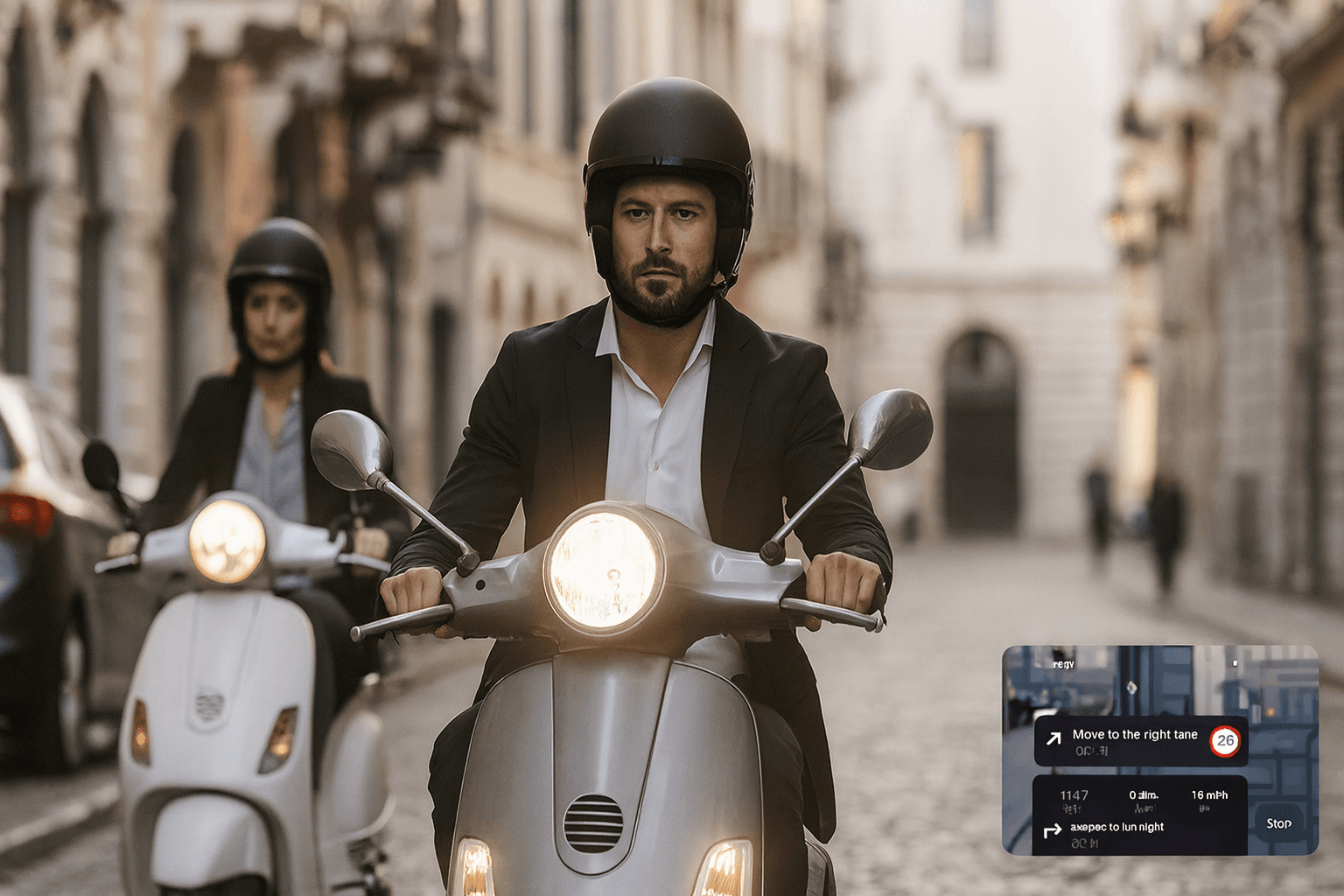
On the move, Minimal Mode strips the screen down to the next instruction, the distance and your speed, which is all you should be reading at a glance on a handlebar mount, a point I make at length in using phone navigation on two wheels. Your next turn also appears on Apple Watch, so the phone can stay clamped to the bars. The app saves your parking location, useful when you have squeezed into a bay three streets from your destination, and for electric riders it surfaces charging points along the route.
The honest caveats: Urban Rider is younger and smaller than the giants, it is iOS-first today with an Android version in open beta, and it will not magically know every borough's latest bus-lane sign. No app does; the sign on the post is always the final word. If you are weighing up the alternatives, I compared the main contenders in our guide to the best scooter and moped navigation apps.
A quick reference for London riders
| Topic | The rule for scooters and mopeds | Cost |
|---|---|---|
| Congestion Charge | Two-wheelers exempt; weekdays 07:00 to 18:00 | £0 (cars £18/day) |
| ULEZ | Free if Euro 3 (registered from July 2007); 24/7 to the Circular roads | £0, or £12.50/day if non-compliant |
| Bus lanes | Allowed on most TfL red routes; many borough lanes excluded, check the sign | £160 penalty if not permitted |
| Cycle lanes and pavement | Never, in either; solid-white cycle lanes are off limits when operating | Penalty and points |
| Parking | Solo motorcycle bays free in ~28 of 33 boroughs; 5 inner boroughs charge | Free, or about £1/day (Westminster) |
Ridden with a little local knowledge, London rewards two wheels more than almost any other major city: cheaper than a car, faster than the Tube on the right day, and genuinely fun once you know the lanes. Learn the signs, respect the cameras, lock the bike properly, and let a navigation app that understands your vehicle handle the rest.
Frequently asked questions
Do scooters and motorcycles pay the London Congestion Charge?
No. Two-wheeled motorcycles, scooters and mopeds are exempt from the London Congestion Charge, which rose to £18 a day from 2 January 2026. You do not need to register or pay to ride through the central zone. Larger motor tricycles above the size threshold are treated as cars and are not exempt.
Does my scooter have to pay the ULEZ charge in London?
Only if it does not meet the Euro 3 emissions standard. Motorcycles, scooters and mopeds first registered with the DVLA from July 2007 are treated as compliant and pay nothing. Older, non-compliant machines pay £12.50 a day to ride anywhere inside the zone, which covers all London boroughs up to the North and South Circular roads.
Can I ride my scooter in London bus lanes and cycle lanes?
Motorcycles and scooters are allowed in almost all bus lanes on Transport for London red routes, but many borough-controlled bus lanes are still cars-and-buses only, so always read the blue sign. You must never ride in a cycle lane marked by a solid white line during its hours of operation, and riding on the pavement is illegal.
Where can I park a scooter in central London and what does it cost?
Use the marked Solo Motorcycle Only bays. They are free in around 28 of London's 33 boroughs. Five inner boroughs charge non-residents: Westminster, Camden, Islington, Hackney and Lewisham. In Westminster a day costs £1, or £100 for an annual permit, and electric motorcycles park free. You may also park on a single yellow line outside its controlled hours.
How likely is my scooter to be stolen in London?
Theft is a real risk: more than 9,000 powered two-wheelers were stolen across London in the last year, though the Metropolitan Police reported the figure falling by about 7 percent in 2025. Park in a busy, overlooked motorcycle bay, use a disc lock and a chain to an immovable anchor, and fit a tracker on anything valuable.